



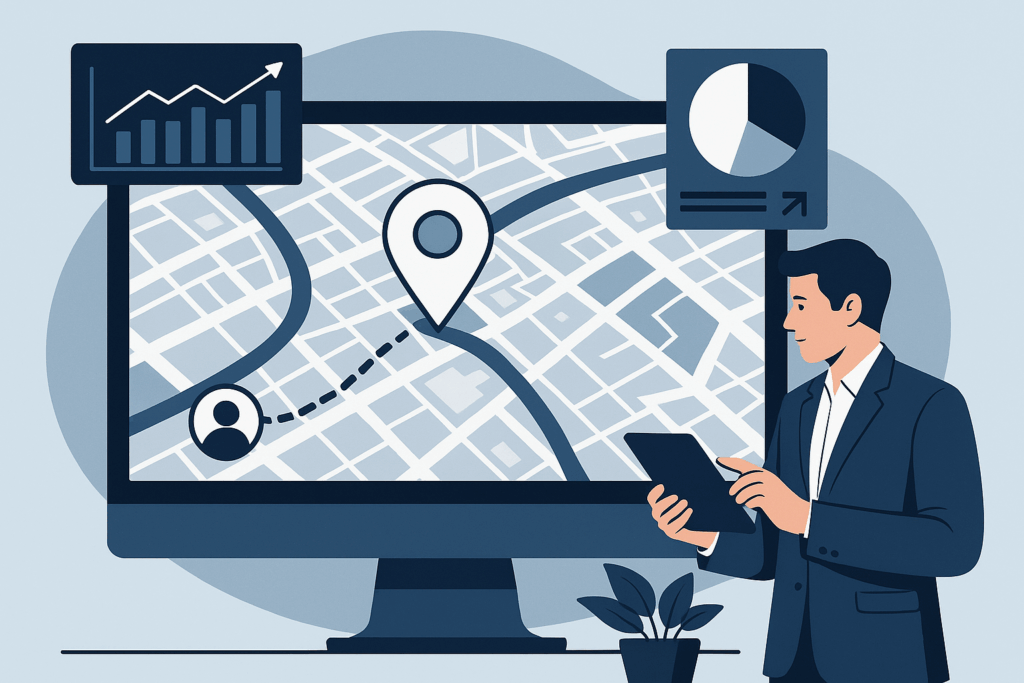
Every property has a map. But if yours looks and functions like everyone else’s, it’s costing you money. In 2025, a basic, cookie-cutter map isn’t just outdated—it’s an obstacle to growth.
Generic solutions can’t capture the unique flow of your visitors, your tenants’ goals, or your marketing potential. They miss the analytics that show where people actually move, what they search for, and how ads perform. And every month without that data is a month of lost traffic and missed sponsorship revenue.
The next wave of property tech isn’t about simply helping people get around. It’s about turning navigation into measurable engagement—and measurable ROI.
Why custom maps are outperforming generic tools
A custom map does more than direct traffic. It builds a data bridge between how people use your space and how you can make that space more profitable.
1. Tailored to your environment
Every property has its own traffic patterns, anchor tenants, and promotional priorities. A custom map adapts to them.
- Shopping centers can highlight retailers, flash sales, or seasonal events in real time.
- Airports can sync flight info, wayfinding, and retail promotions.
- Universities can update routes instantly for construction or events.
- Commercial real estate portfolios can visualize occupancy and visitor flow across multiple sites.
2. Drives measurable engagement
Custom maps transform “visits” into trackable behaviors—searches, dwell time, ad clicks, and navigation routes. This gives marketing teams live insight into what visitors want, when they want it, and where they’re spending the most time.
3. Unlocks new revenue streams
Maps aren’t just for navigation anymore—they’re marketing platforms. On-map advertising and push notifications let you monetize visitor attention, sell ad space to tenants or sponsors, and deliver context-aware promotions based on location and time.
The ROI of customization
For decision-makers, the value of a custom mapping solution is easy to quantify:
- Higher ad performance: Targeted, location-based ads see 2–3x higher engagement than static banners.
- Longer dwell times: Personalized routes and promotions increase visitor stay duration and purchase intent.
- Smarter leasing decisions: Analytics dashboards identify high-value zones, justifying rent adjustments.
- Operational efficiency: Real-time updates replace costly reprints and manual signage changes.
When every touchpoint—from kiosk to QR code—feeds data into a unified system, the result is a clear, defensible ROI that generic mapping vendors can’t deliver.
What “custom” really means in 2025
The best mapping platforms go beyond branding and colors. They integrate into your full tech stack:
- Omnichannel access across mobile, kiosks, and web
- AI-powered assistants that answer visitor questions via text, voice, or photo
- Accessibility options like audio guidance and wheelchair-friendly routes
- Lidar-based 2D/3D modeling for spatial accuracy and immersive visualization
- Advanced analytics that translate movement into marketing intelligence
These aren’t luxury add-ons—they’re the new baseline for digital experience.
A case in point: when custom maps outperform templates
Consider the Decked Out Detroit Field Guide, built on MapVX for Bedrock ahead of the 2024 NFL Draft. With over 775,000 visitors downtown, the interactive digital map helped attendees find parking, restaurants, and events in real time while collecting analytics on traffic flow and search behavior.
The result: smoother navigation, stronger vendor engagement, and measurable ROI for both the property owner and tenants—proof that a custom implementation drives outcomes no off-the-shelf map could match.
Why properties are upgrading now
The demand for custom maps is accelerating because operators are realizing three things:
- Visitor expectations are shaped by AI, not static signage.
- Brands need digital touchpoints they can monetize.
- Data—not foot traffic alone—determines a property’s value.
Waiting until 2026 means competitors will already have months of analytics, sponsorships, and customer insights ahead of you.
How MapVX delivers measurable ROI
MapVX is the benchmark for custom mapping software—used by airports, shopping centers, universities, and large events worldwide.
- Tailored implementations built from your floor plans and brand assets
- AI-powered assistance that helps guests locate destinations through natural conversation
- Omnichannel access via mobile, web, and kiosk, so users stay connected across platforms
- Integrated advertising tools for push promotions and on-map campaigns
- Analytics dashboards to visualize foot traffic, dwell times, search trends, and ad performance
From design to deployment, MapVX aligns navigation, marketing, and analytics into one revenue-driven system with dedicated support to keep your maps evolving as your property grows.
The takeaway
“Good enough” maps can get people from A to B. But custom mapping software helps you understand why they go there, how they move, and what drives them to spend more. That insight is the difference between offering directions—and driving results.
Don’t settle for static. Build the map that moves your business forward.
Book a demo to see how a MapVX custom implementation can turn your traffic into ROI.