




Location intelligence software has quietly become one of the most valuable tools for large venues. Shopping centers, airports, universities, stadiums, and commercial properties are using it to understand how people move, what they search for, and where they spend time. The result is a new level of control over customer experience and revenue generation. Waiting until next quarter means losing this quarter’s behavioral data and your competitive edge. Every property leader wants clearer visibility into what drives foot traffic and sales. Location intelligence software delivers that visibility by turning movement patterns, searches, and on site engagement into measurable business value.
Why Location Intelligence Software Is Becoming a Revenue Engine
Operators today face a consistent problem: too much data scattered across disconnected systems. Foot traffic counters show volume but not intent. POS systems show sales but not what led to them. Static maps reveal layout but not how people navigate it. Location intelligence brings these signals together, giving leaders a complete picture of how visitors interact with a space.
This clarity drives decisions that directly affect the bottom line. Marketing teams can target promotions to zones with proven demand. Facilities teams can reduce chokepoints and rethink high dwell but low performing corridors. Leasing teams can price units by proof, not guesswork.
Across shopping centers, airports, and campuses, properties are using location intelligence to answer questions that were previously unanswerable: Which areas have untapped revenue potential? Which categories drive the most searches? Which vendor placements reduce friction? Which events actually increase movement and sales?
How Location Intelligence Turns Foot Traffic Into Actionable Revenue
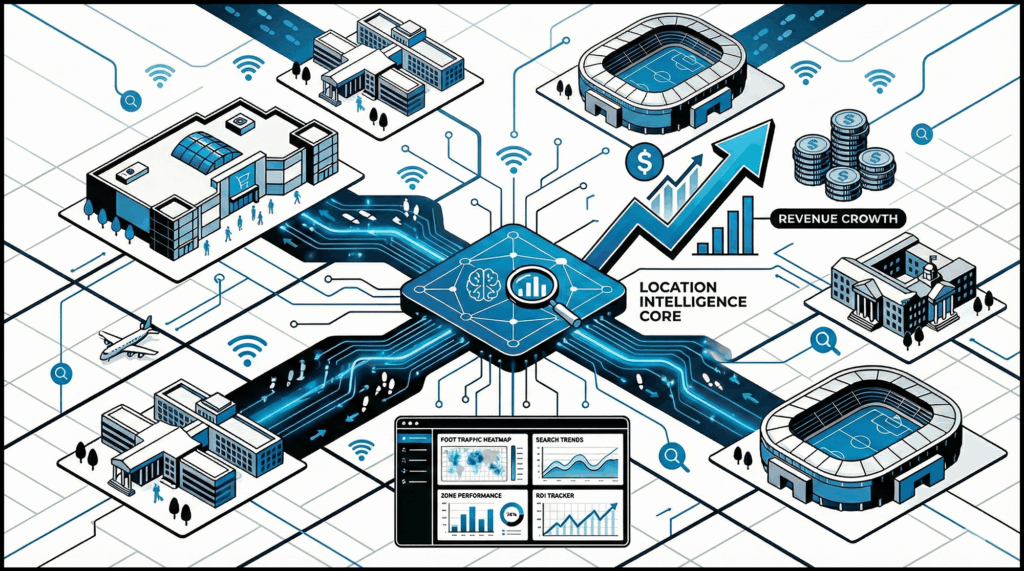
Location intelligence software goes far beyond basic traffic analytics. It reveals the full context of behavior so operators can act in real time.
Examples include:
• Identifying high dwell areas that underperform commercially
• Clustering search patterns to uncover unmet needs or product demand
• Flagging congestion during peak hours
• Tracking how events shift behavior throughout the day or week
• Measuring the performance of marketing campaigns across zones
For venues with retail components, this becomes especially powerful. Searches for specific brands or categories expose actual intent. Routing patterns reveal how many visitors bypass key tenants. Heat maps highlight mobility challenges or zones that could support promotional activation.
In airports, location intelligence helps teams understand traveler dwell zones near dining and retail. Universities gain visibility into student traffic patterns by time of day or semester. Commercial real estate owners use these insights to justify lease renewals, negotiate rates, and improve tenant mix strategy.
What Modern Venues Gain From Location Intelligence
Most venue operators underestimate how many decisions can be improved with visitor behavior data. Location intelligence software supports leaders across operations, marketing, IT, and property management.
Key advantages include:
• Data driven layout optimization that reduces friction and boosts flow
• Search trend visibility that highlights brand and category demand
• Zone level reporting that exposes areas with untapped revenue potential
• Seasonal and time based behavior patterns that improve planning
• Benchmarking tools to measure changes after openings or promotions
• Real time event analytics that justify sponsorship value
For marketing teams, clarity around what drives conversions is a major advantage. You can see whether on map promotions lead to routing spikes. You can test whether QR code placements generate mobile engagement. You can compare pre and post event performance by the hour. This finally closes the loop between promotions and ROI.
How AI Is Reshaping Location Intelligence
As AI powered search and navigation become standard in public spaces, location intelligence becomes even more valuable. AI assistants integrated into map interfaces support visitors with natural language requests, product lookups, and visual queries. This interaction data becomes a new feedback layer for operators.
When users ask the AI assistant for a specific product or brand, demand patterns are logged. When people upload photos or ask for directions, each interaction strengthens the behavior map. Voice and text queries reveal language preferences and accessibility needs.
Venues gain the ability to analyze not just movement and routing but also the intent behind every request. This allows operators to anticipate needs, refine customer journeys, and plan staffing or inventory more accurately.
Where MapVX Fits Into the Location Intelligence Landscape
Most platforms stop at heat maps or simple routing data. MapVX goes further by combining maps, search behavior, heat maps, promotions performance, and AI assistant engagement into a unified analytics dashboard.
Clients use MapVX to capture every interaction across web, kiosk, mobile, and QR driven maps. They can track how visitors navigate, what they search for, which zones they prefer, and how they respond to ads or events.
MapVX’s analytics dashboard provides visibility into foot traffic, dwell time, keyword trends, promotions performance, and route creation. Reporting is available across mobile and kiosk touch points with intuitive filters for day, time, event, or location.
Because MapVX runs across multiple interfaces, the dataset is broader and more accurate. Operators get visibility not just into traffic patterns but into customer motivations.
MapVX’s AI assistant adds a new layer of intelligence by capturing voice, text, and image based requests. This helps teams understand what visitors need in real time and what they cannot find easily on their own. As budgets reset in Q1, venues that capture Q4 behavioral data now will enter the new year with a meaningful advantage.
Conclusion
The venues that adopt location intelligence software now will outperform those that wait. Every week without a behavioral dataset means missed opportunities to improve operations and revenue. As budgets reset in Q1, the properties that invest today will enter the new year with stronger insight, clearer customer understanding, and better tools for driving ROI.
If you want to start capturing meaningful engagement signals before the quarter ends, MapVX can help. Book a demo to see how your venue can turn movement, search behavior, and on site engagement into measurable revenue.
Book a demo today to see how location intelligence can transform your venue.