



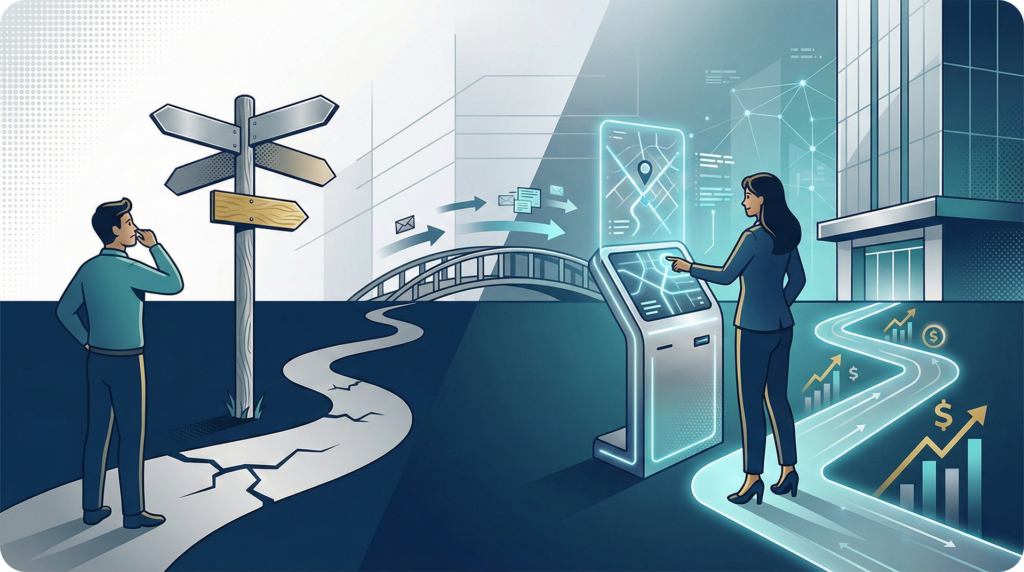
Static directory boards and printed maps cost more than their price tag suggests. Every tenant change triggers reprinting. Every visitor question pulls staff from higher-value tasks. And critically, traditional signage generates zero data about what’s actually working. Digital wayfinding signage eliminates these inefficiencies while creating entirely new revenue streams through integrated advertising, real-time analytics, and measurable visitor engagement.
For property managers and operations leaders evaluating this investment, the business case comes down to three factors: cost reduction, revenue generation, and data-driven decision making. The numbers favor digital on all three fronts.
The Hidden Cost of Static Navigation
Traditional signage carries expenses that rarely appear on balance sheets. Printing costs accumulate with every tenant change. Staff time evaporates answering the same directional questions. Most critically, there’s no way to measure whether your signs actually work.
Consider what static signs cannot do:
- Track which stores visitors search for most frequently
- Deliver targeted promotions based on location or time
- Update instantly when tenants change or events occur
- Provide accessibility accommodations beyond basic compliance
- Generate revenue through advertising placements
These limitations translate directly to lost opportunities. When a visitor can’t find what they need quickly, they leave. When you can’t measure behavior, you can’t optimize layouts or justify premium lease rates with data.
Quantifying the Digital Advantage
Digital wayfinding signage transforms passive infrastructure into active revenue drivers. The ROI calculation extends far beyond simple cost comparisons.
Revenue Generation Interactive digital kiosks create new advertising inventory. Sponsored listings, geofenced promotions, and time-based offers turn navigation touchpoints into monetizable moments. Properties using integrated advertising tools report measurable increases in tenant visibility and foot traffic to promoted locations.
Operational Savings Real-time updates eliminate printing cycles entirely. When a store relocates or a temporary event activates, changes reflect instantly across all platforms. Staff redirect their time from answering basic questions to higher-value customer interactions.
Data-Driven Decision Making Perhaps the most significant ROI factor involves what you learn. Advanced analytics reveal search trends, dwell times, and traffic patterns that inform everything from lease negotiations to marketing strategy.
Traditional vs Digital: A Side-by-Side Comparison
| Factor | Traditional Signage | Digital Wayfinding Signage |
|---|---|---|
| Update Speed | Days to weeks | Instant |
| Ongoing Costs | Printing, installation | Minimal after deployment |
| Revenue Potential | None | Advertising, sponsorships |
| Analytics | Zero visibility | Real-time behavioral data |
| Accessibility | Basic compliance | Audio guidance, wheelchair routing, multi-language |
| Scalability | Linear cost increase | Marginal cost per addition |
Building Your Business Case
Justifying digital wayfinding investment requires connecting features to outcomes your stakeholders care about. Operations leaders want efficiency. Marketing teams want measurable channels. Asset managers want tenant performance data.
The strongest proposals address all three simultaneously. Modern wayfinding solutions deliver turn-by-turn navigation that reduces confusion while capturing the search and behavior data that proves campaign effectiveness.
For properties evaluating providers, several factors separate solutions that deliver ROI from those that simply digitize existing problems:
Multi-Platform Deployment Systems should work seamlessly across kiosks, mobile devices, and web interfaces. QR code handoffs let visitors transfer routes from public screens to personal phones, extending engagement beyond the kiosk interaction.
Integrated Monetization Built-in advertising capabilities with performance tracking transform navigation from cost center to revenue stream. Look for platforms offering geofenced notifications, sponsored listings, and measurable ad analytics.
Accessibility Leadership Beyond compliance, inclusive design expands your addressable visitor base. Audio-guided navigation, wheelchair-optimized routing, and multi-language support ensure every customer can navigate effectively.
Implementation Timeline and Expectations
Modern deployment timelines have compressed significantly. MapVX, for example, implements complete digital wayfinding systems in as little as six weeks, including LiDAR scanning for precision 3D environments, custom branding, and staff training.
The implementation process typically includes:
- Spatial data collection and floor plan digitization
- Custom interface design matching brand guidelines
- Directory integration with tenant information
- Kiosk hardware installation and mobile deployment
- Analytics dashboard configuration
- Team training and ongoing optimization support
Properties that approach digital wayfinding as a strategic platform rather than a simple sign replacement see returns multiply over time. Each dataset informs better decisions. Each promotion proves measurable impact. Each visitor interaction becomes an opportunity to convert.
Making the Decision
The question facing property managers isn’t whether digital wayfinding signage delivers better outcomes than traditional signs. The evidence is clear. The real question is how quickly you can capture these advantages before competitors do.
For shopping centers, airports, and commercial properties evaluating their next move, the path forward starts with understanding exactly what’s possible. Book a demo to see how MapVX transforms navigation into measurable revenue and actionable insights.